Why Four-Year-Olds Solve Problems Like Computer Scientists
Have you ever watched a four-year-old figure out how to reach the cookie jar on the top shelf? First, they scan the room. Then they drag over a chair. Maybe stack a pillow on top. Test it - adjust. Try again.
That’s not random chaos - that’s algorithmic thinking in action.
Recent research from MIT and UC Berkeley has been turning heads in developmental psychology circles. Turns out, preschoolers use surprisingly sophisticated problem-solving strategies-ones that mirror how computer scientists approach complex challenges. And no, these kids haven’t been secretly attending coding bootcamps.
The Brain’s Natural Debugging Process
When software engineers encounter a bug, they don’t just randomly click buttons hoping something works. They use systematic approaches: isolate variables, test hypotheses, iterate based on results.
Four-year-olds - same deal.
A 2023 study published in Developmental Science tracked how preschoolers approached novel problems-things like figuring out which blocks activated a light-up toy. The researchers expected messy, trial-and-error behavior. What they found was way more interesting.
Kids as young as 3. 5 years old consistently isolated single variables when testing their theories. They’d change one thing at a time, observe the result, then adjust their hypothesis. Sound familiar - that’s basically the scientific method. Or, if you prefer tech terminology, that’s debugging.
Here’s what really surprised researchers: when kids’ initial hypotheses failed, they didn’t just guess randomly. They systematically eliminated possibilities - one block didn’t work? Okay, try the next one - that failed too? Must be about combinations, not single pieces.
Pattern Recognition Starts Earlier Than You’d Think
Pattern recognition sits at the heart of computational thinking. It’s how algorithms categorize spam emails, how Netflix figures out you’ll probably love that obscure documentary about cheese-making.
Preschoolers are pattern-recognition machines. But not in the ways most parents realize.
Watch a four-year-old play with a shape sorter. After a few attempts, most kids stop trying to jam the square through the circle hole. That’s obvious learning, right - but there’s something subtler happening.
Researchers at Stanford found that preschoolers don’t just learn “square goes in square hole. " They extract underlying rules. Given a totally new shape they’ve never seen, kids apply pattern logic: “This has straight edges like the square, so it probably goes in that straight-edged opening.
That’s abstraction-taking specific examples and deriving general principles. It’s exactly what a machine learning algorithm does when it’s trained on data.
Decomposition: Breaking Big Problems Into Tiny Pieces
Asked a preschooler to clean their entire room? You’ll probably get tears or a blank stare. The task is too massive, too abstract.
But frame it differently. “First, let’s put the books on the shelf. Now let’s find all the red toys. " Suddenly, they’re engaged and effective.
This is more than a parenting hack. It’s called decomposition in computer science-breaking complex problems into manageable sub-problems.
And but: kids naturally do this when left to their own devices. A study from the University of Texas observed children aged 4-5 attempting to build a specific LEGO structure from a picture. Without any adult guidance, most kids spontaneously broke the task down. First the base - then the walls. Then the roof.
They weren’t taught this strategy - their brains just… did it.
The researchers noted something else fascinating. Kids who struggled initially often paused, looked at the whole picture, then literally pointed to different sections-creating mental “modules” before attempting each one. Computer scientists call this modular thinking.
Why Does This Matter For Parents?
So your preschooler thinks like a programmer. Cool. What do you actually do with this information?
First, resist the urge to solve problems for them. I know-it’s painful watching your kid spend fifteen minutes trying to figure out how their shoe goes on. But that struggle? That’s their brain building neural pathways that’ll serve them for decades.
Second, ask better questions. Instead of “Do you need help? " try “What have you tried so far? " or “What do you think will happen if you try it this way?
These questions are more than feel-good parenting strategies. They’re prompts that encourage metacognition-thinking about thinking. And metacognition is what separates competent problem-solvers from exceptional ones.
Third, embrace productive failure. When your kid’s block tower falls for the sixth time, they’re not failing. They’re iterating - each collapse gives data. Too tall - base too narrow. Wrong starting block.
A Carnegie Mellon study found that children who experienced “desirable difficulties”-challenges that caused initial failure but were solvable-showed stronger problem-solving skills six months later than kids who succeeded easily on simpler tasks.
The Limits (Because Nothing’s Perfect)
Let’s be real: four-year-olds aren’t actually computer scientists. They have serious limitations that any honest discussion needs to acknowledge.
Working memory, for one. Preschoolers can hold maybe 2-3 pieces of information in mind simultaneously. Complex multi-step reasoning often falls apart because they literally forget what they were doing mid-process.
Emotional regulation is another bottleneck. A frustrated four-year-old doesn’t calmly debug their approach. They melt down. The computational machinery is there, but the emotional infrastructure to sustain it through difficulty is still under construction.
And attention span - yeah. That cookie-jar problem-solving brilliance might last four minutes before something shiny catches their eye.
But here’s the hopeful part: these limitations are developmental, not permanent. The algorithmic thinking patterns exist. The hardware just needs time to mature.
Simple Ways To Support Computational Thinking
You don’t need fancy apps or expensive STEM toys. Seriously.
Cooking together involves sequencing, measurement, and cause-effect relationships. What happens if we add the eggs before mixing the dry ingredients? Let’s find out.
Sorting laundry is pattern recognition and categorization. By color - by person? By fabric type? There’s no wrong answer-just different algorithms.
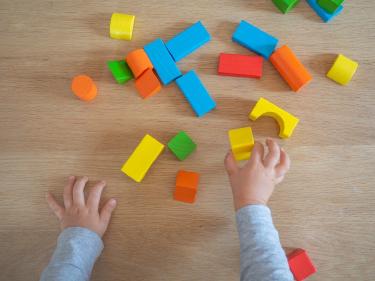
Building with blocks covers spatial reasoning, structural engineering basics, and iterative design. Plus, destruction is half the fun.
Playing “What’s My Rule - “ is pure logical thinking. You sort objects into groups and kids guess the rule. Green things - things that start with B? Things you’d find at the beach? Then let them make rules for you to guess.
Treasure hunts with clues require sequential thinking and logical deduction. Make clues slightly too hard, then watch them puzzle it out.
The key isn’t finding the “right” activity. It’s stepping back and letting your kid struggle productively with whatever’s in front of them.
Looking Ahead
Twenty years ago, computational thinking was a niche term used mostly by academics and tech educators. Now it’s recognized as a fundamental literacy-as essential as reading or arithmetic for handling modern life.
The good news? Your four-year-old already has the foundation. Their brain is wired for exactly this kind of thinking.
Your job isn’t to teach them how to think like a computer scientist. It’s to not get in the way of what they’re already doing naturally.
So next time you see your preschooler intensely focused on figuring out why their toy train won’t go down the track they built, resist the urge to fix it. Pull up a chair - watch the algorithm run.
You might learn something.