Why Risky Play Is Essential for Your Child's Growth
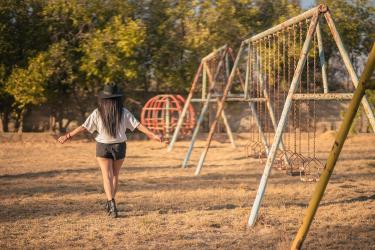
Remember when you were a kid and climbed that tree in your backyard? The one your mom told you was too tall? Your palms got sweaty, your heart raced, and when you finally reached that high branch, you felt like you could conquer anything.
That feeling wasn’t just fun - it was building your brain.
What Exactly Is Risky Play?
Risky play is any thrilling, exciting activity where kids sense a possibility of physical injury. Climbing trees - balancing on logs. Jumping off playground equipment - playing near water. Using real tools - roughhousing with friends.
Sounds terrifying when you list it out, right?
But but. Kids are wired to seek this stuff out. They’re not being reckless or disobedient when they climb higher than you’d like. They’re following millions of years of evolutionary programming that says: “Test your limits. Learn what your body can do.
Norwegian researcher Ellen Sandseter identified six categories of risky play that children naturally gravitate toward:
- Great heights - climbing, jumping, balancing
- High speed - swinging fast, sledding, biking downhill
- Dangerous tools - hammers, saws, knives (with supervision)
- Dangerous elements - fire, water, cliffs
- Rough-and-tumble - wrestling, play fighting
- Disappearing/getting lost - exploring alone, hide and seek in new places
Kids don’t need us to teach them to seek these experiences. They do it instinctively. What they need is the space to actually do it.
Your Child’s Brain on Adventure
When your kid stands at the top of a tall slide, their brain lights up like a Christmas tree. Adrenaline floods their system. Their prefrontal cortex-the part responsible for decision-making and risk assessment-kicks into high gear.
They’re calculating - can I do this? What might happen - is this worth it?
And when they go down that slide and nothing terrible happens? Their brain files that experience away. They learn they can handle scary situations. They develop what psychologists call “stress inoculation”-small doses of manageable fear that build resilience over time.
A 2017 study in the International Journal of Environmental Research and Public Health found that children who engaged in more risky outdoor play showed lower levels of anxiety and better emotional regulation than their more sheltered peers.
That’s not a coincidence.
The Playground Paradox
Here’s something that might surprise you. Countries with “safer” playgrounds actually see more injuries. Meanwhile, places like Germany and Denmark, where adventure playgrounds feature loose parts, high structures, and even supervised fire pits, report fewer serious accidents.
How does that work?
When everything is rubber-coated and risk-free, kids get bored. They find ways to make things dangerous. They stand on top of the equipment instead of climbing it properly. The team twist swings into knots. The team take risks the equipment wasn’t designed for.
But give kids genuinely challenging environments, and they pay attention. They assess. They’re careful because the stakes feel real.
Tim Gill, author of “No Fear: Growing Up in a Risk Averse Society,” puts it this way: kids have a natural risk thermostat. Remove all risk from their environment, and they’ll find ways to add it back-often in less safe ways.
Physical Benefits That Last a Lifetime
Risky play is more than about building brave kids. It builds stronger ones.
Climbing develops grip strength, upper body power, and coordination that no structured gymnastics class can replicate. Jumping teaches kids to absorb impact and land safely-a skill that prevents injuries for years to come. Rough-and-tumble play builds proprioception, the ability to sense where your body is in space.
Research from the University of British Columbia found that preschoolers who engaged in more active outdoor play had better motor skills by kindergarten. And these differences persisted. Kids who climbed, jumped, and ran freely in early childhood showed better physical literacy at age seven.
Your child’s bones are also paying attention. Weight-bearing activities like jumping and climbing stimulate bone growth. Kids who spend their early years on padded indoor surfaces miss this key development window.
But What About Injuries?
Yes, kids get hurt doing risky things. Scraped knees - bruises. Occasionally a broken bone.
But consider this: a broken arm from falling out of a tree heals in six to eight weeks. Anxiety disorders that develop from never learning to manage fear? Those can last decades.
I’m not saying throw caution to the wind. Obviously, we’re not letting toddlers play with chainsaws. The goal is calibrated risk-challenges appropriate to your child’s developmental stage and abilities.
A good rule of thumb: if your child is choosing to do something risky, they’ve probably assessed they can handle it. Kids are generally pretty good at knowing their limits. The ones who climb to the highest branch are usually the ones with the skills to get there.
The injuries that send kids to the emergency room most often? They come from organized sports and car accidents. Not tree climbing - not adventure playgrounds. Not the “dangerous” free play we’ve spent decades eliminating.
How to Let Go (Without Losing Your Mind)
Knowing risky play is good for your kid and actually allowing it are two different things. Your protective instincts are powerful - they’re supposed to be.
So start small.
Next time you’re at the playground and your child starts climbing higher than feels comfortable, take a breath before you yell. Watch their face - are they confident? Focused - then they’re probably fine.
Ask yourself: what’s the worst that could realistically happen? Most of the time, it’s a scraped knee or a bruised ego. Painful but not catastrophic.
Try this phrase: “That looks tricky. What’s your plan? " It acknowledges the challenge without shutting them down. And it makes them think through their approach.
You can also:
- **Position yourself as a spotter rather than a preventer. ** Stand close enough to catch a fall, not close enough to stop the climb. - **Let them solve problems before jumping in. ** Stuck on a rock? Give them a minute to figure it out. - **Talk about risks openly. ** “What do you think could happen if you jump from there? Is it worth it? "
- **Share your own childhood adventures. ** Kids love hearing about the dumb things you survived.
The Harder Truth
Look, I get it. We live in a world that feels dangerous. The news is terrifying - other parents judge. And our own childhood scraped knees have faded into distant memory.
But the data is clear. The biggest risk to our children’s health and development isn’t tree climbing or rough play. It’s sedentary, screen-filled, bubble-wrapped childhoods that never teach them what they’re capable of.
Children who never face manageable risks grow into teenagers who can’t assess danger accurately. They either become paralyzed by anxiety or swing to the opposite extreme, seeking thrills without the skills to handle them.
The playground scraped knee today prevents the reckless driving tomorrow.
What Risky Play Really Teaches
When your kid stands at the edge of a creek, deciding whether to leap to the rock on the other side, they’re not just building muscles.
They’re learning:
- How to assess whether a challenge is within their ability
- What fear feels like-and that it won’t kill them
- That they can handle difficult situations
- How to pick themselves up when things go wrong
- That the world is a place they can explore, not a minefield to fear
These lessons don’t come from apps. They don’t come from structured activities with constant adult supervision. They come from skinned knees and triumphant grins and “Mom, did you see what I just did?!
So the next time your child wants to climb a little higher, run a little faster, or play in a way that makes your stomach clench-consider saying yes.
Their future self will thank you for it.